From planned works two years ahead to real-time constraint relief, ForeGrid helps distribution operators anticipate, decide and act with confidence.
Electricity grid operators are currently experiencing the effects of an accelerated energy transition through the rapid integration of DER, new and fast-growing uses of electricity and the expansion of flexibility mechanisms. This complexity calls for anticipation, responsiveness, and arbitrage capacity.
By combining the operational DNA of Enedis (EDF Group), ranked #1 globally in the Singapore Smart Grid Index, with the analytical delivery rigor of Sia, a global management consulting leader in data science and AI, we partnered to develop ForeGrid, a state-of-the-art and innovative grid solution that addresses the evolving needs of network operators by providing a custom-made, versatile and forward-thinking platform.
We are convinced that an efficient and reliable grid must be operated with a long-term perspective. ForeGrid integrates planned network works to safeguard grid readiness and streamline operator decisions from T-2 years to real time and beyond, with proactive constraints optimization that drives higher customer satisfaction.
Scheduling planned works on the grid with minimal impact on grid readiness
Accounting for HR constraints and projected state of the grid
Real-time identification of constraints (intensity, tension, power) on the grid
Decision support to remedy the constraints at minimal cost
After grid recovery (automated and out of scope), plan to ensure the resilience of the grid
Identify potential weaknesses & solutions
Built to be SCADA-agnostic, ForeGrid integrates into your existing environment, whether on-premise or in the cloud, eliminating vendor lock-in and significantly reducing deployment complexity.
ForeGrid’s algorithms have been specifically designed for robustness and for their ability to parallelize computations within very short timeframes, leveraging combinations of control levers to address both system complexity in real time and an increasing growth of DER.
Hence, several loadflow algorithms were developed to estimate the electrical network state (voltage, current, etc.) based on its loads, power consumption/production (Backward-forward, Newton-Raphson, Holomorphic Embedding).
ForeGrid’s optimization engine is based on the latest research achievements in operational research: the optimizer applies a set of levers to the network and evaluates their impact by running a loadflow evaluation. This process is repeated for all tested levers. The optimizer aims to maximize the objective while ensuring that all network constraints are respected.
By utilizing advanced parallel processing and high-fidelity solvers, our algorithms deliver faster, more precise calculations across massive datasets, allowing for a significantly higher volume of simultaneous simulations with near-zero latency.
Assess the potential impacts of planned works and identify the optimal time window for scheduling them.
On the day before execution, assess the feasibility of planned works and, where applicable, determine the actions to be activated to remove or mitigate constraints. Postpone the works if necessary.
Monitor the grid for emerging constraints and, where applicable, optimize the mitigation actions to be activated to relieve or reduce them, either automatically or periodically.
Verify the effectiveness of activated actions and, where applicable, propose a new optimization.
ForeGrid has been designed from the outset to provide a high level of transparency, which is particularly critical both for operators who need to be confident in the tools they use and for external stakeholders that may be compensated through market-based solutions.
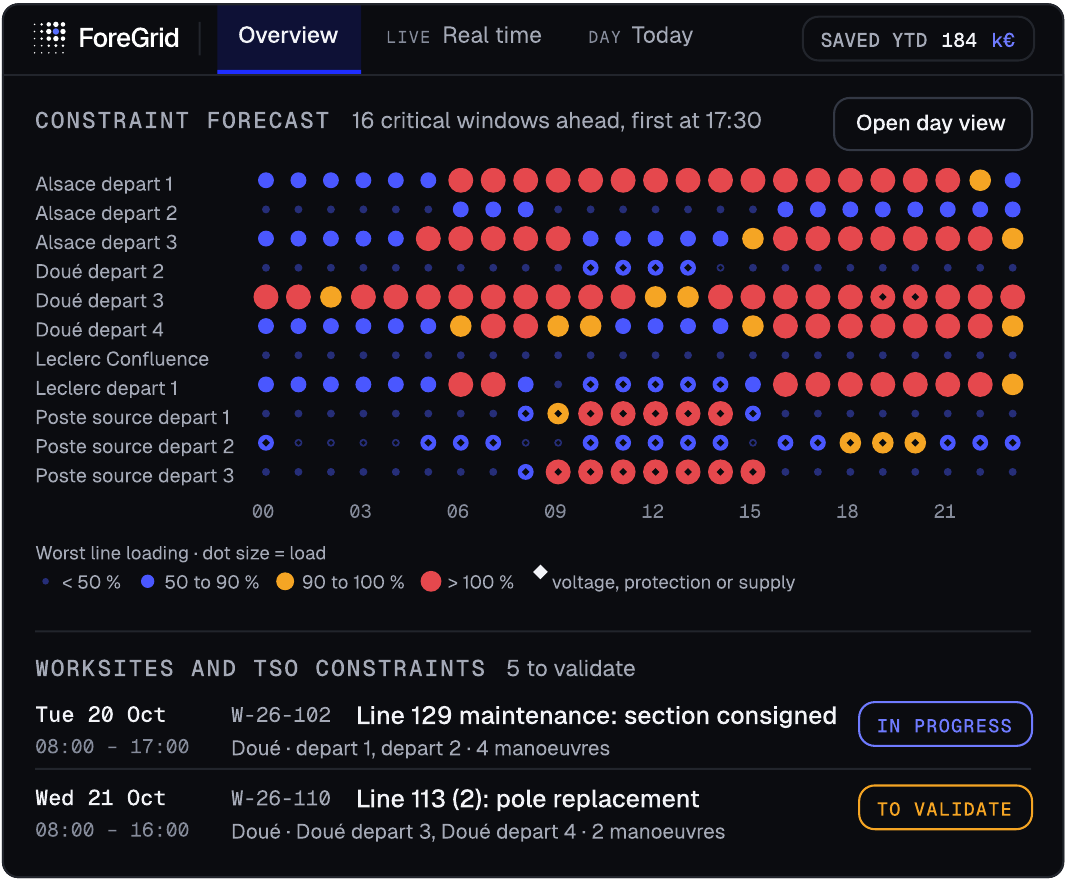
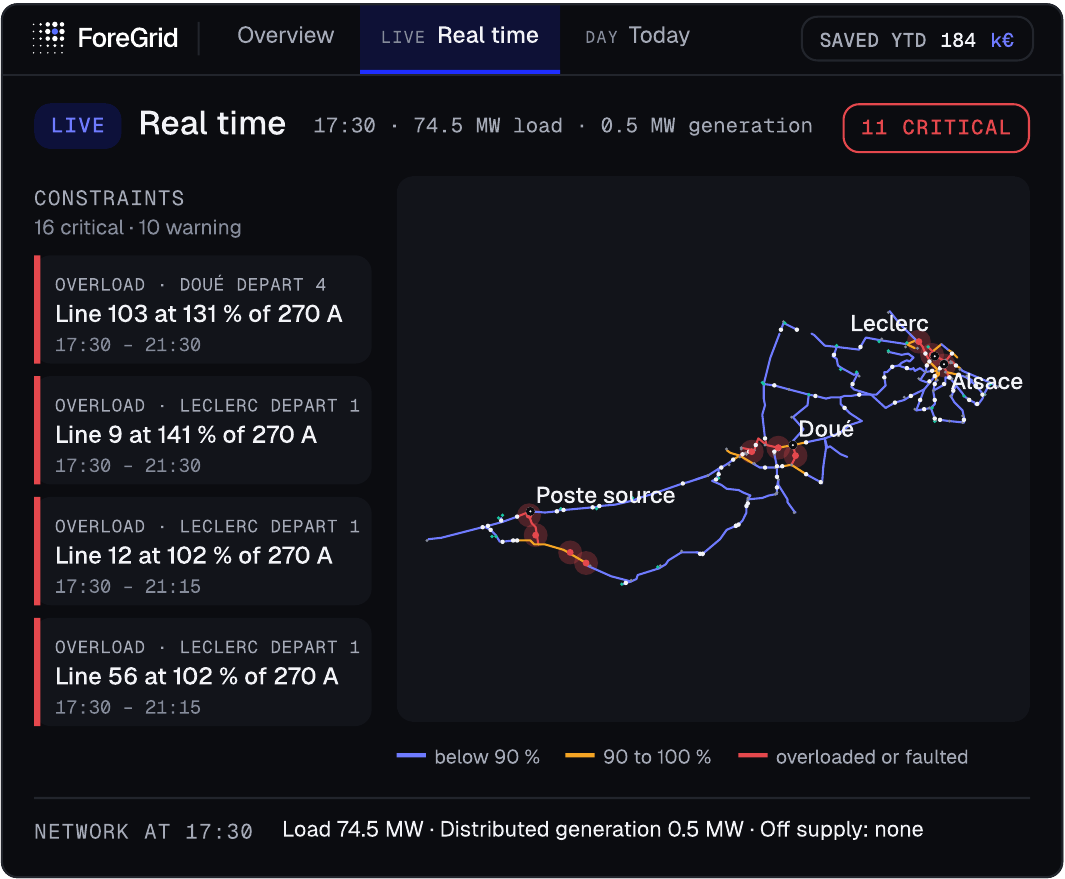
ForeGrid will leverage the HMI already in use within the existing SCADA/ADMS ecosystem. However, we can also develop new HMIs, thanks to our deep understanding of network representation challenges and the accurate visualization of grid assets and their components.
This approach guarantees smooth integration, long-term scalability, and independence from vendor-specific technologies, while complying with current and future regulatory and cybersecurity requirements.
ForeGrid is fully compatible with a wide range of industry standards and communication protocols and supports CIM-based information models, aligned with IEC 61968/61970. It is designed to seamlessly integrate within existing IT and OT environments by supporting DNP3 and RESTful APIs, ensuring interoperability with third-party systems such as SCADA, ADMS, EMS, GIS…
Our solution also complies with internationally recognized cybersecurity standards such as ISO/IEC 27001 for information security management, IEC 62443 for industrial and OT cybersecurity, and NIST frameworks for critical infrastructure protection, while ensuring secure communications through standards like IEC 62351.
ForeGrid is designed for flexible, large-scale deployment. It relies on a common functional core, while allowing local parameterization of business rules, thresholds and operational settings: “deploy once, adapt locally”.
A modular architecture designed for performance with a high level of adaptability
Business rules are fully configurable to reflect regional or entity-specific requirements.
Deployment can be carried out in waves, enabling a progressive ramp-up and controlled change.
Feature flipping allows functionalities to be activated gradually, limiting operational risk.
A structured change management approach based on our strong experience ensures user adoption and operational mastery.
EDF IN, the international grid distribution division of the EDF group, brings a DSO perspective to DERMS deployment, going beyond technology and system integration.
Building on extensive experience supporting DSOs worldwide, we combine DERMS expertise with a strong understanding of grid operations, business processes and operational challenges.
This is the key to a successful rollout of ForeGrid and, ultimately, its effective adoption by the teams who will use it every day.

ForeGrid is being deployed at scale with Enedis, building on its operational expertise and real-world grid requirements.